RTCFM Research Projects
Grand Challenge 1: The Copper Challenge
ANU is co-leading six and contributing to a further three research projects in Phase 1 and Phase 2 of The Copper Challenge.
Grand Challenge 2: Circularity of Energy Storage Materials
Expressions of Interest are now closed for project proposals aligned to Grand Challenge 2.
Building a First Nations Research Agenda for the Centre for Future Materials (WP00)
First Nations peoples around the world are disproportionately impacted by climate change, the extraction of natural resources and the transitions shaping the future of energy. Yet their voices, knowledge systems, and priorities are often excluded from research and decision-making processes — especially in industries like copper mining that affect land, water and sovereignty.
If we are to transition to a just and sustainable future, research must be shaped and led by First Nations communities — not just be about them. This means building enduring, respectful relationships that empower First Nations leadership and insight in addressing the global copper challenge and beyond.
This work package (WP00) forms Phase 1 of the Centre’s First Nations Research Agenda. It lays the groundwork for meaningful collaboration with First Nations communities in Australia, while preparing for future engagement with Indigenous groups internationally.
Rather than beginning with a predefined research agenda and outputs, WP00 focuses on building the right foundations: trust, capability, and co-designed priorities. It aims to invest in the relationships and structures needed to ensure First Nations-led knowledge systems shape the future direction of research at the Centre — from copper extraction to broader energy transition challenges.
Lead university: The Australian National University
Collaborators: Ngarluma Yindjibarndi Foundation Ltd, the University of the Witwatersrand, University of British Columbia
ANU research team: Peter Yu, Nick Bainton, Nicky Drake, Jenna Harb, John Taylor, Noah Bedford, Christian Barry, Kirsten Mann, Mandy Yap, Sujatha Raman, Rini Astuti


Knowledge Review and Mapping (WP-1)
Current knowledge about copper deposits, extraction methods, supply chains and socio-environmental impacts is scattered across disciplines, regions and perspectives. Much of it reflects industrial or geopolitical priorities, while Indigenous knowledge systems and community experiences remain underrepresented.
Without a holistic, transdisciplinary view of copper's past, present and future, our efforts to transform its use and reduce its impacts risk missing the bigger picture.
This research sets the foundation for all future work at the Rio Tinto Centre for Future Materials by assembling a comprehensive knowledge base on copper: its geology, supply chains, processing, environmental legacy, governance systems and cultural meanings.
Lead universities: University of California Berkeley and the University of the Witwatersrand
Collaborators: The Australian National University, Imperial College London
ANU research team: Nick Bainton, Rini Astuti
Social-environmental-technological integration (WP001)
This research explores how to better integrate social, environmental and technological perspectives when designing solutions for the future of materials. It does so by building a shared framework and set of methods that can guide transdisciplinary collaboration from the outset, instead of as an afterthought.
We are developing the foundational research structures that will guide the Centre’s research at the extraction-energy transition nexus. Our framework will strengthen the Centre’s technical and scientific outputs by connecting and integrating expertise and methods from social sciences, environmental studies, humanities and traditional knowledge. The result? A systems-thinking approach that allows us to co-design solutions that are not only technically effective, but also socially just and environmentally responsible.
The challenge isn’t just coordination, it’s synthesis: creating tools that help make sense of different ways of knowing, evaluating impacts and setting priorities.
Lead universities: The Australian National University, Imperial College London
Collaborators: University of California, Berkeley, University of British Columbia and the University of the Witwatersrand
ANU Research team: Sujatha Raman, Caitlin Byrt, Karina Judd, Nick Bainton, Tim Senden, Andrew Berry, Rini Astuti

Post Waste (WP8)
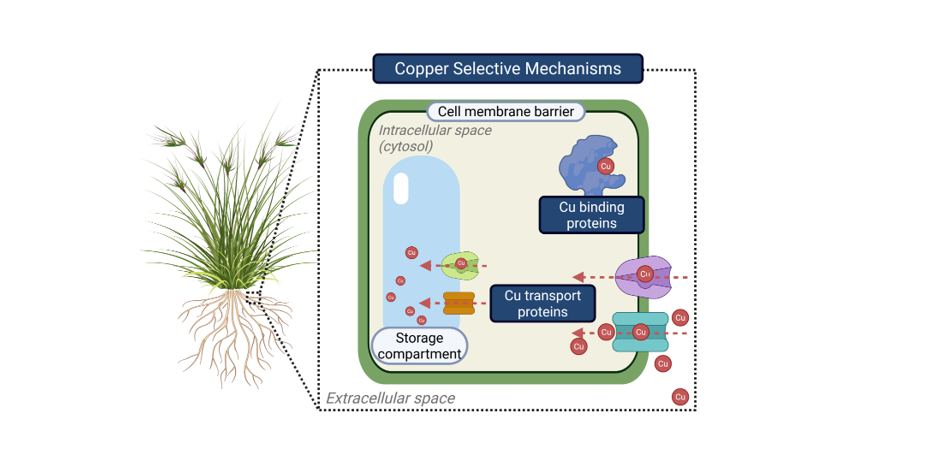
Across the world, mine waste piles contain hundreds of billions of tons of copper locked away in forms that are too complex, costly, or polluting to extract using today’s standard mining technologies. These dormant materials sit idle — a lost resource and an ongoing environmental risk.
At the same time, the global demand for copper is skyrocketing, driven by the expansion of electric vehicles, renewable energy, and next-generation electronics. We urgently need new ways to meet this demand without expanding the environmental footprint of mining.
This project is reimagining mine waste — not as a burden, but as a potential copper resource that could be unlocked through sustainable innovation.
The idea is to create ecosystems-of-resources: integrated systems of biology, materials science, and engineering that work together to extract copper from waste while simultaneously remediating environmental harm. By combining advanced technologies with natural processes, we can recover copper from materials once considered worthless — and in doing so, turn waste sites into productive, cleaner landscapes.
Lead universities: The Australian National University, Imperial College London, University of British Columbia
Collaborators: Rio Tinto
ANU research team: Caitlin Byrt, Sujatha Raman, Samantha McGaughey, Yeorgia Argirou, ZhouYi Wang
Biomining (WP13)
As the demand for copper continues to surge, we face a stark reality: conventional mining methods are unsustainable for the long haul. Traditional extraction relies on high temperatures, chemicals, and heavy infrastructure — often producing large amounts of waste and environmental harm, especially when targeting low-grade ores. But what if we could mine copper the way nature does? Quietly, precisely and with far less waste.
Biomining turns to some of the smallest organisms on the planet — microbes — to solve one of the biggest challenges in modern mining. By leveraging the unique abilities of bacteria, archaea, fungi, and the viruses that infect them this research is exploring how to extract copper from ores and waste materials in ways that are cleaner, more efficient, and more adaptable to varied environments.
Microorganisms naturally break down minerals, releasing metals like copper into soluble forms — a process known as biohydrometallurgy. This method not only reduces environmental impact but also enables extraction from low-grade ores and mine waste that would otherwise go unused.
But copper biomining isn’t without its complexities. Each microbe behaves differently depending on ore type, temperature, pH, and other factors. To make biomining a scalable, effective alternative, the process must be precisely tuned — and that’s where biotechnology innovation comes in.
Lead universities: Imperial College London, University of British Columbia
Collaborators: The Australian National University, the University of the Witwatersrand
ANU research team: Caitlin Byrt, Thomas Loan, Yeorgia Argirou, ZhouYi Wang
CuBrine: metal extraction from natural magmatic brines (WP12)
Copper is essential to the energy transition. From power grids to electric vehicles, the demand for this critical metal is soaring — but traditional mining methods are facing serious limits. They’re energy-intensive, water-hungry, and often environmentally and socially disruptive. As we accelerate toward a low-carbon future, we urgently need new ways to access copper — ones that reduce harm, use fewer resources, and leave a lighter footprint on the planet.
What if we could extract copper without digging massive open-pit mines? That’s the bold idea behind CuBrine.
This project explores whether copper and other critical metals can be extracted directly from deep, naturally occurring brine reservoirs beneath volcanic and magmatic systems. These ultra-salty fluids, circulating kilometres beneath the Earth’s surface, are rich in metals — and may hold the key to a radically different extraction method.
Using a closed-loop system of boreholes, the research team aims to bring these hot brines to the surface, extract the metals, and then re-inject the fluid back underground. It’s a method inspired by geothermal energy production — and one that could offer significantly lower energy use, dramatically reduced water consumption, and minimal surface disruption.
Lead universities: The Australian National University, Imperial College London, University of British Columbia
ANU research team: Andrew Berry, Laura Crisp


Gem-Cu: Geodynamic Environments for Mineralisation of Copper (P2Cu-3)
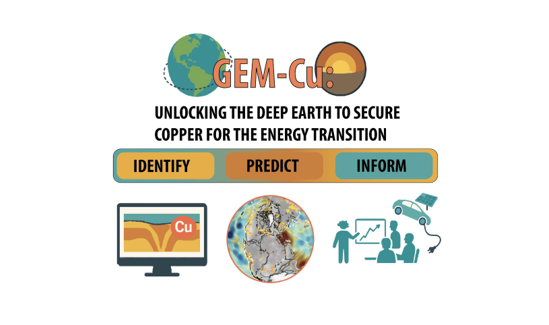
A sustainable, low-carbon future depends on copper. It powers clean energy technologies – from electric vehicles to solar panels and wind farms. But global demand is soaring, and the world is running out of easily accessible copper. Without new discoveries, the energy transition could stall. GEM-Cu will help change that.
We’re building a Virtual Earth – a revolutionary digital model that looks deep inside our planet and far back in time to understand how copper deposits form. Traditional exploration methods focus on surface clues – geological mapping, geochemical sampling, and geophysical surveys. But these approaches often overlook the deeper geodynamic processes that govern where copper is actually generated. Key factors like how tectonic plates move, where Earth’s crust is under stress, and how mantle rocks flow all play a vital role in forming copper deposits – yet exploration models rarely take these deeper processes into account.
Our project fills that gap. We’ll use world-leading tools developed by our team to map known copper deposits through space and time, integrating geological and geophysical datasets to identify the tectonic regimes and deep Earth dynamics triggering their formation. By coupling tectonic and mantle models over more than a billion years of Earth history, we’ll create a robust 4-D geodynamic framework that pinpoints the conditions necessary for copper ore genesis – and their evolution. This process-based approach moves beyond conventional exploration, which relies on past discoveries, and instead anticipates where new deposits are likely to be found.
With the help of machine learning, we’ll turn this deep-time science into predictive models. This will make copper exploration more efficient, cost-effective, and sustainable, reducing reliance on intrusive and environmentally disruptive techniques. By narrowing the search space and targeting exploration where it matters most, our approach may help unlock new, large-scale copper resources while aligning with the broader goals of the green energy transition.
And we’re not stopping at scientific discovery. To ensure this knowledge is applied with confidence, we’re investigating how people interpret and act on model predictions. By combining geoscience, decision theory, and human-centred design, we’re exploring how predictive tools can be understood, trusted, and adopted. Through co-designed visualisations, training modules, and targeted engagement with technical users, we aim to build confidence in the science and shape the conditions that support future innovation uptake.
Lead universities: The Australian National University, Imperial College London, University of British Columbia
ANU research team: Rhodri Davies, Grace Shepherd, Malcolm Sambridge, Mark Hoggard, Janice Scealy, John Taylor, Angus Gibson

Co-designing multi-value frameworks for transparent and ethical copper supply chains (P2Cu-7)
This project aims to transform copper supply chains by co-designing innovative socio-environmental technical frameworks that embed plural values at every stage of the mining life cycle.
Copper is essential for renewable energy technologies, but its extraction can mean that nearby communities and ecosystems suffer a tremendous cost. There is a need for current copper sourcing methods to consider how to better incorporate concerns around the environment and cultural relationships with the land. When economic value and technical efficiency are prioritised, this can risk conflict across landscapes, among communities, and within the mining industry itself. Even mining companies express growing frustration with the long, uncertain paths to project approval and delivery. Current ESG frameworks are failing to manage these tensions. A root cause is a failure to account for plural values. Copper mining decision-making remains dominated by economic and technical priorities. While social, ecological, and cultural values are increasingly acknowledged, they are still poorly understood and weakly embedded in decision-making across mining policies, practices and processes. This knowledge gap results in mistrust, conflict, delay, and potential failure. To address this, our research will co-design innovative socio-environmental-technical frameworks by working directly with local communities—alongside engineers, policymakers, and scientists. These frameworks will strengthen the role of community consent in decision-making and reduce risks in mining projects. We begin by understanding the multiple, plural values that communities and stakeholders hold for copper and the land it comes from. Next, we examine how current practices and policies intended to shape energy transitions recognise, or ignore, these values. Finally, we co-design new ways of planning and governing copper’s supply chain that respect ecosystems, reflect community priorities, and uphold the right to give or withhold consent.
Lead universities: The Australian National University, Imperial College London, University of British Columbia, the University of the Witwatersrand
ANU research team: Rini Astuti, Nick Bainton, Caitlin Byrt, Sujatha Raman, Jasper Montana